
Enterprise Landscapers: How to Scale Bidding Capacity Without Adding Overhead
How $5M+ landscape contractors systemize bidding to handle 3x volume with flat headcount. Advanced frameworks for capacity scaling and margin protection.

Key Takeaways:
Key Takeaways
- Operational ceiling: Bidding capacity—not quoting speed—limits $5M+ growth. Estimators are the bottleneck.
- Measurement automation saves 6 months' salary: Redeploy talent to pricing strategy (Priority Landscape case study).
- Standardization protects a 5-15% margin variance: Without it, the same job gets quoted at $5.5K-$8K.
- 4-phase framework enables Q1-Q4 roadmap: Clear path eliminates execution risk and enables confident planning.
- Quote-to-execution alignment prevents margin erosion: Three-way sign-off catches disconnects early.
- Enterprise peer success proves feasibility: Level Green saves 250+ hours/month; Priority reduced from 8 days to 24 hours.
- Competitive advantage = faster, data-backed proposals: Your quotes arrive in less than 24 hours; competitors' in 3+ days.
Executive Summary for Operations Leaders
For $5M+ landscape contractors, bidding capacity affects the business growth more than quoting speed. Estimators are buried in manual measurements. You're turning away RFPs due to capacity. Each estimator costs $65K-$85K+ annually but only marginally increases bid volume.
Enterprise contractors who systematize bidding eliminate this bottleneck without adding headcount. By decoupling measurement from estimation, standardizing production rates, and implementing margin-protected pricing. This has helped established firms handle 3x bid volume with existing teams.
The Three Structural Barriers Preventing Scaling
Barrier 1: Manual Measurement is a Headcount Bottleneck
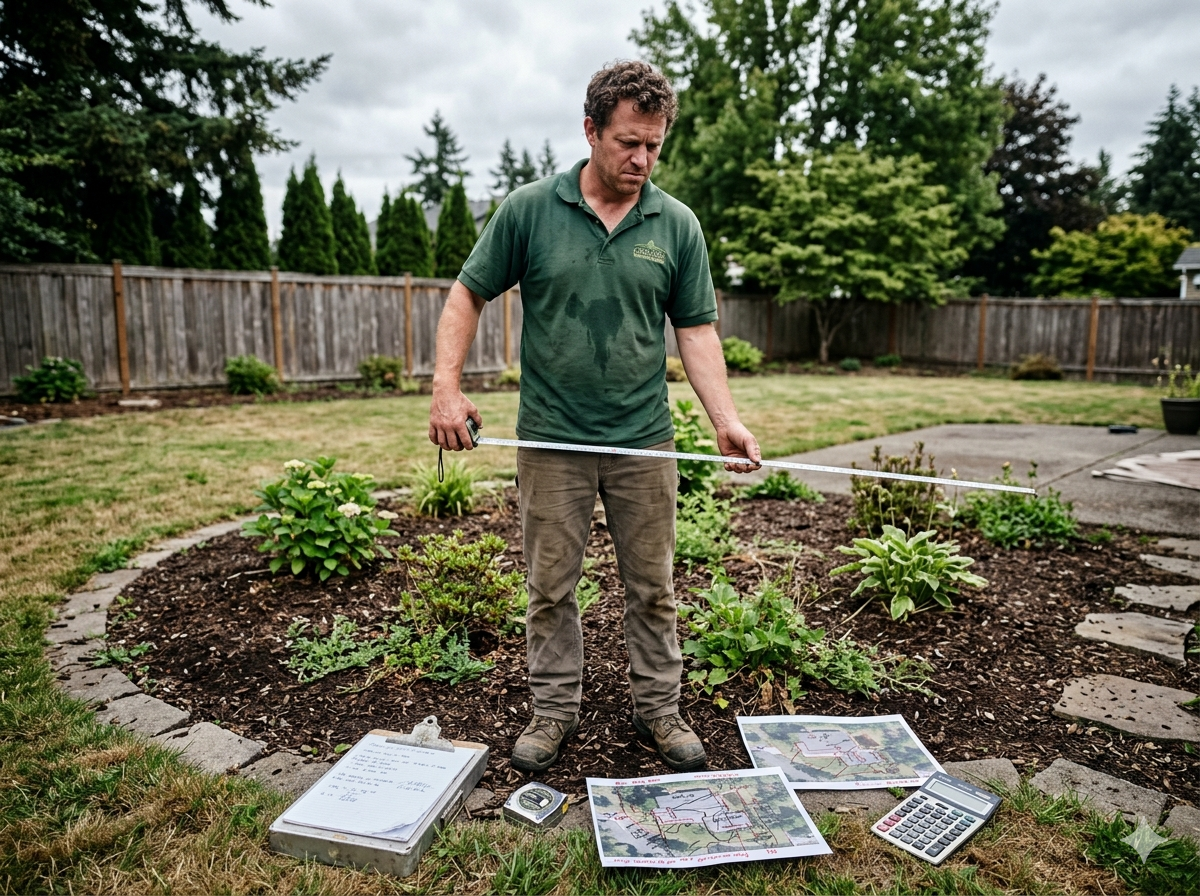
The Reality: Your experienced estimators spend 6-8 hours on complex properties just to gather measurement data. Multiply that across 20+ weekly bids, and you've allocated 120-160 hours of professional labor to the most commoditizable part of the job.
The Impact:
- The manual measurements brings a high risk of errors
- Field crews re-measure during execution ("The quote said 30K sq. ft., but it's actually 45K") This creates estimation variance across your team.
- You can't scale reliably without eliminating this bottleneck
The Solution: Decouple measurement from estimation. Use SiteRecon's AI-powered remote takeoffs to capture precise property data in 24-48 hours (or instantly for standard properties <20 acres). This frees your best talent to focus on pricing strategy and margin optimization.
SiteRecon Result: Priority Landscape Maintenance saved the equivalent of 6 months of a full-time salary by automating measurements. They now bid on properties in under 24 hours that previously took 8 days. View Case Study
Barrier 2: Estimation Inconsistency Creates Margin Leakage
The Reality: Without standardized production rates:
- Estimator A: Mulch = 12 sq. ft./man-hour (optimistic)
- Estimator B: Mulch = 18 sq. ft./man-hour (conservative)
- Estimator C: Mulch = 15 sq. ft./man-hour (realistic)
Same job gets quoted at $8K, $5.5K, and $7K—undermining pricing power and creating sales-operations friction.
Why It Matters:
- Multi-location operators struggle to maintain consistency
- Sales reps lack confidence in estimates, leading to price concessions
- You can't scale reliably without knowing what "normal" looks like
- 5-15% margin variance compounds across your portfolio
The Solution: Build standardized production rate libraries grounded in actual performance data. Service-line estimating (mowing, beds, hardscape, irrigation) lets your whole team speak the same language.
SiteRecon Capability: Service-layer configurable packages map each property feature to its related service. Once set, production rates apply consistently across all estimators. Learn More
Level Green Result: 250+ sales hours saved monthly through automated takeoffs tied to consistent production rates. Read the complete success story
Barrier 3: Quote-to-Execution Disconnect Erodes Profitability
The Reality: Your estimate assumes 30K sq. ft. of turf under specific conditions. Field crew finds 45K sq. ft., poor drainage, and uneven terrain. Crew productivity drops (estimated 12 hours, actual 18 hours). Materials cost overruns. Margin compresses.
Why It Matters:
- Estimates built on incomplete property intelligence fail in execution
- This happens because sales and operations don't agree on assumptions before work begins
- Margin erosion on large jobs can wipe out profits from smaller ones
The Solution: Create a three-way sign-off process. Before presenting any estimate, ensure sales understands the scope, operations confirm feasibility, and finance approves margins. Use property mapping to create shared visual references that both teams agree on.
SiteRecon Capability: Complete audit trail from takeoff to proposal to execution. Contractors measure actual performance against estimated rates and adjust future bids accordingly. See How
Yardmaster Result: COO Michael Montenaro uses AI measurements to keep teams accountable. Accurate data helps the whole team understand what they're working with before jobs start. Read through to know their journey
These barriers are the bottleneck for most companies following the manual or semi-manu process of measurement. But for the company who are scaling and turning in successful enterprise, the story is just the opposite. Here is how:
The Enterprise Bidding Framework (4 Phases)
Phase 1: Systematize Property Intelligence (Discovery & Measurement)
Goal: Capture complete, accurate property data in a standardized format. This is your single source of truth.
Implementation:
- Remote measurement layer: SiteRecon's AI-powered takeoffs measure properties in 30 seconds (under 5 acres) to 24-48 hours for properties over 20 acres (complex)
- Visual documentation layer: Mark-up property maps for on-site validation; create a shared reference for sales and operations
- Data integration layer: Feed measurements directly into the estimating system; eliminate transcription errors
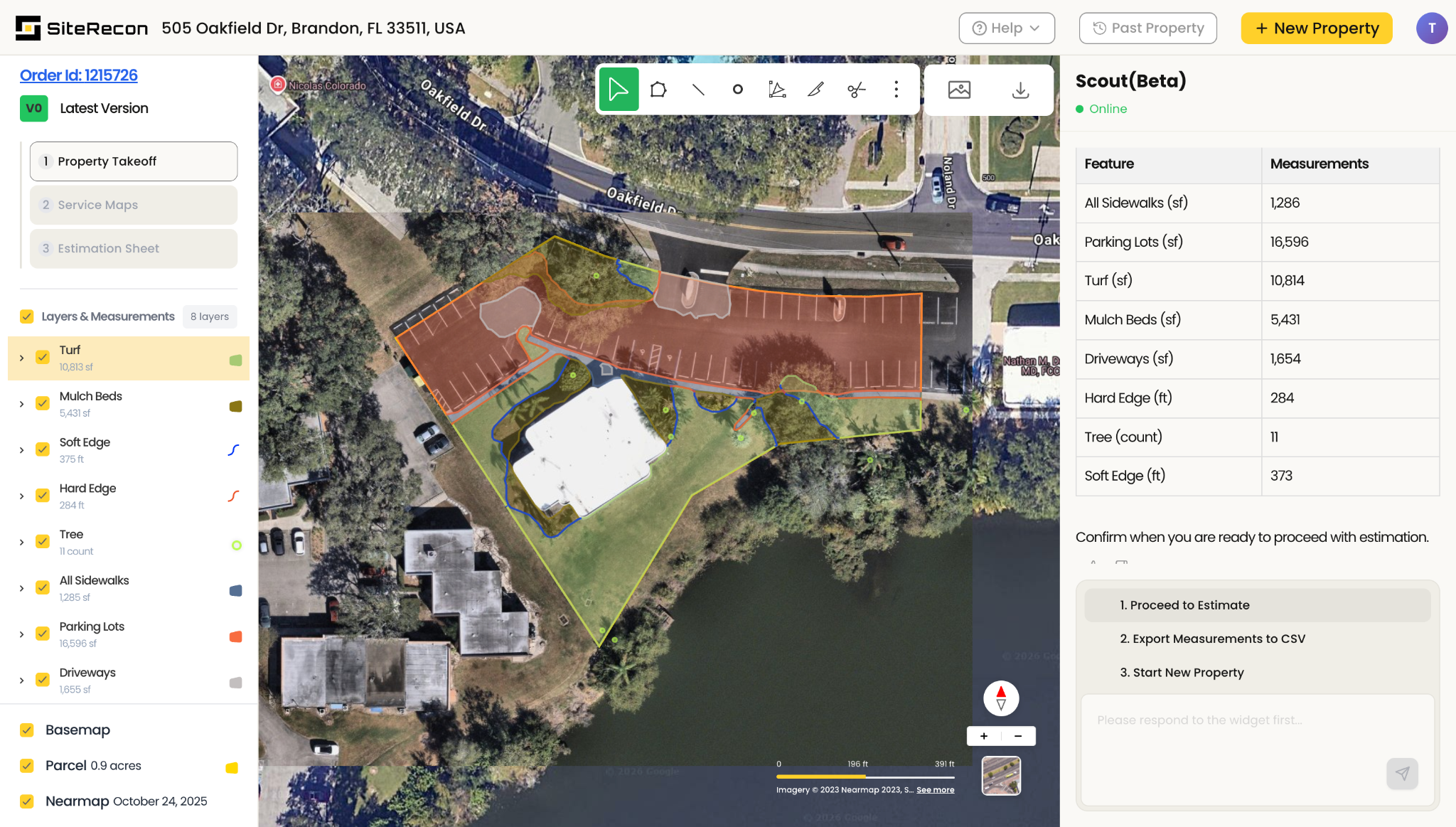
Enterprise Win: Tyler Jabaay (Priority Landscape): "With SiteRecon, we moved from spending hours on manual measurements to having accurate data at our fingertips in record time. This has transformed how we approach proposals.” Full Case Study
Phase 2: Standardize Production Rates by Service Line
Goal: Every team member operates from the same realistic production rates. This eliminates estimation variance.
Implementation:
- Data mining: Pull actual performance from the last 12-24 months of projects
- Rate library: Build service-line matrices by complexity tier (standard, complex, HOA-restricted, multi-service)
- Quarterly updates: Adjust rates quarterly based on new job data, labor costs, and crew progression
SiteRecon Capability: Production rate libraries integrate directly into the estimating system. Consistent rates are automatically applied across all estimators.
Enterprise Win: Contractors report "noticeable increases in efficiency and accuracy across estimating teams, with increased throughput and improved output quality."
Ready to protect your margins with data-driven pricing? Explore how SiteRecon's service-layer estimating creates consistent production rates across your entire team: → Explore SiteRecon Estimator
Phase 3: Build Margin-Protected Pricing Logic
Goal: Apply consistent markup rules that protect profitability across all service lines.
Implementation:
- True cost accounting: Calculate actual delivery cost for each service (labor + materials + equipment + overhead)
- Tiered pricing: Different margins for recurring maintenance (25-30%), installations (35-45%), complex commercial (30-40%)
- Discount authority: Pre-approve authority by position (sales: 5% max, regional manager: 10% max, VP: 15% max)

Example: Mulch installation: $100/CY cost → $140/CY bid (40% margin) in competitive range of $130-$150/CY
SiteRecon Capability: Estimator applies margin rules consistently; bakes pricing standards into every quote.
Phase 4: Institutionalize Quote-to-Execution Alignment
Goal: Ensure operations receive a complete, accurate scope before mobilization.
Implementation:
- Three-way sign-off: Sales, operations, and finance review before client presentation
- Production tracking: Compare actual crew hours/materials to estimate; adjust future rates if patterns emerge
- Quarterly reviews: Analyze bidding accuracy by estimator (win rate, margin accuracy, production variance)
SiteRecon Capability: Complete audit trail enables real-time tracking. Build feedback loop: actual performance → rate adjustments → better estimates.
Advanced Scaling Strategies for $5M+ Operations
Multi-location standardization enables large contracts. Recurring revenue optimization focuses on maintenance crews. Seasonal capacity planning (40 bids/week spring, 20 bids/week summer, 35 bids/week fall, 10 bids/week winter) allocates resources efficiently. Competitive positioning: your 24-hour data-backed proposals outpace competitors' 3-day sketches.
Implementation Timeline for Enterprise Teams
Quarter 1: Phase 1 + 2 (Measurement + Production Rates)
- Implement remote measurement (SiteRecon integration)
- Build a production rate library from historical jobs
- Outcome: Faster measurement, consistent estimating
Quarter 2: Phase 3 (Pricing Logic)
- True cost accounting by service line
- Build a tiered pricing architecture
- Implement the discount authority framework
- Outcome: Margin-protected pricing, sales confidence
Quarter 3: Phase 4 (Quote-to-Execution)
- Three-way sign-off process
- Production rate feedback system
- Quarterly performance reviews
- Outcome: Operational alignment, continuous improvement
Quarter 4: Advanced Scaling
- Multi-location optimization
- Seasonal capacity planning
- Competitive positioning playbook
- Outcome: Capacity for enterprise-scale opportunities
Ready to Scale Bidding Without Adding Overhead?
Enterprise contractors who systematize bidding gain a sustainable competitive advantage: faster quotes, confident sales teams, protected margins, and the capacity to pursue larger contracts.
SiteRecon enables all four phases:
- Phase 1: AI-powered remote takeoffs eliminate manual measurement
- Phase 2: Service-line standardization creates consistent estimating
- Phase 3: Margin-protected pricing rules built in
- Phase 4: Complete audit trail enables continuous improvement
See how Priority Landscape, Level Green, and other enterprise contractors have scaled: View All Case Studies
Schedule a strategic consultation to discuss your scaling challenges: Request Enterprise Demo
FAQs
Build an adjustment factor framework. Standard mulch = 15 sq ft/hour. Difficult access = 15 × 1.3 = 11.5 sq ft/hour. Track results and refine quarterly based on actual performance.
SiteRecon enables Phase 1 (remote takeoffs), Phase 2 (production rates in estimating), Phase 3 (margin rules applied), and Phase 4 (audit trail feedback). It's foundational to all four phases, not just one feature.
4-8 weeks with good historical job data. Start with the 12 most common service combinations; extend from there. According to industry best practices, contractor teams typically see measurable improvements within this timeframe.
Document the variance. Often reflects real differences (terrain, labor costs, climate). Build tiered rates that account for this. Use quarterly reviews to identify outliers and understand why they exist.
Most enterprise contractors see payback within 2-3 months (labor savings alone). Full benefit (margin protection + capacity scaling) shows in 6-9 months as you accumulate data and refine production rates.
Take your business to the next level
Find out how SiteRecon's AI remote takeoff and land measurement tools can speed up pipeline, improve bid accuracy and increase sales


.png)
