How $5M+ Landscapers Set Hourly Rates That Drive Profitability
Learn how $5M+ landscapers calculate true costs and use zone-based pricing to recover 15-25% margin. Calculate labor, equipment, insurance, overhead, and non-billable hours accurately.

Key Takeaways:
Key Takeaways
✓ Hourly rates ≠ profitability — Calculate actual costs first. Most operators find 20-30% variance between zones.
✓ Your real cost is 2-3x your stated rate — Labor, equipment, insurance, and overhead add up to $37-56/hr minimum. Most charge $35-55/hr.
✓ Non-billable hours silently kill margins — Travel, admin, and maintenance consume 12-16 hours per crew weekly. Ignored, that's $15K-$50K lost annually.
✓ Zone-based pricing recovers 15-25% margin — Multi-location operators underpricing primary markets by 10-15% are leaving $50K-$200K on the table annually.
✓ Recurring revenue changes how you price — At 80% recurring, you price for profit. At 60% one-off, you price defensively and lose margin every month.
The Problem Most $5M+ Landscapers Face
You know labor costs are rising. As per the U.S. Bureau of Labor Statistics (BLS), wages increased 3.3% year-over-year, and benefit costs 3.4% (December 2025). With the variance of equipment breakage, insurance price increase etc. Yet your hourly rates haven't kept pace.
But here's the real problem: You don't know if you're profitable on each job.
You charge $50/hour. That is the calculation that you did based on the time spent for the job, but the margin after the job felt thin. Why? Because you've never calculated your actual cost per billable hour. The difference between the costs that you thought was way higher than what it actually costs. And in multi-location operations, that varies significantly by zone.
$10M+ operators know this down to the dollar, broken down by zone, crew, and service type. Most who haven't done this analysis find that inconsistent pricing costs $50K-$200K+ annually.
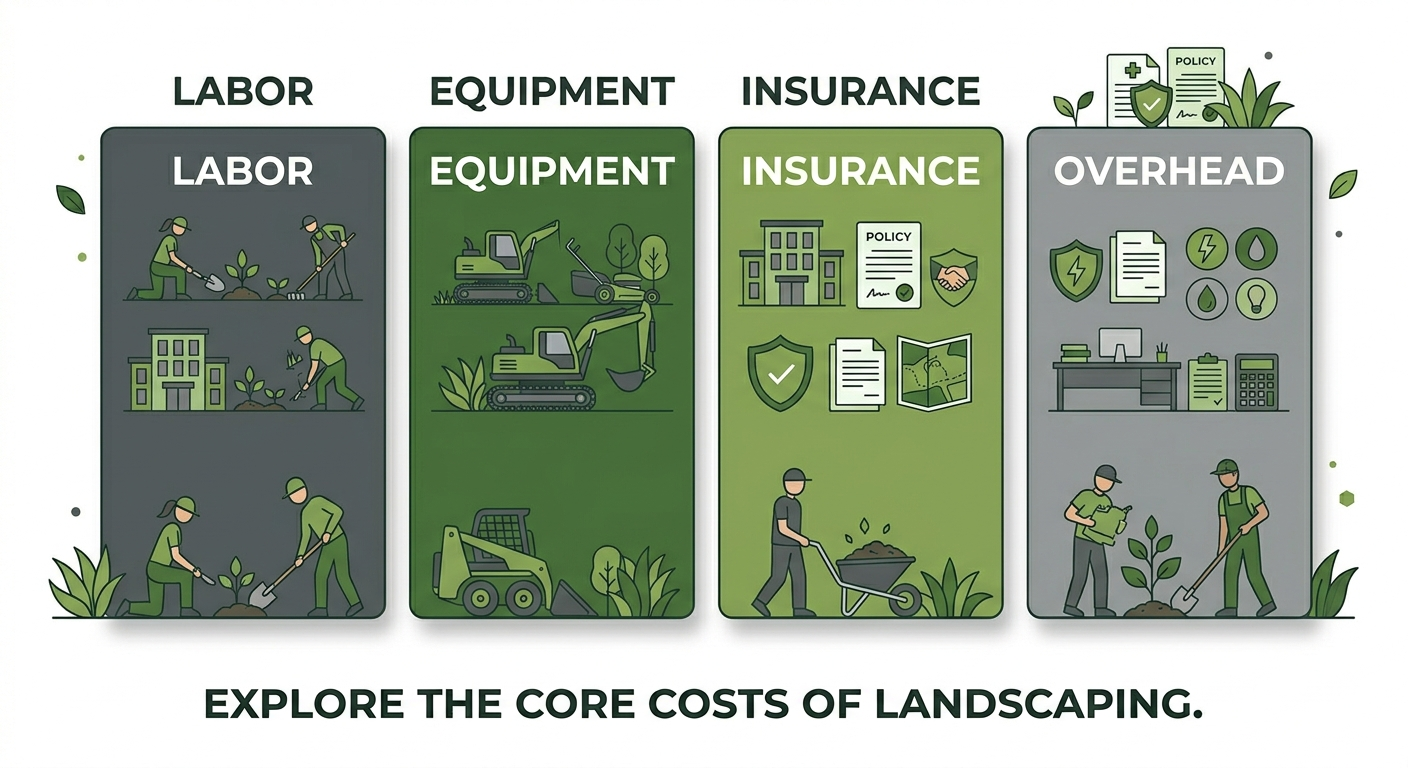
Your True Cost Per Billable Hour
The median hourly wage for grounds maintenance workers was $18.50 in May 2024 (BLS). That's the floor—not the full cost.
Most $5M+ landscapers charge $35-55/hour. Look at that gap. The difference between what you charge and what you actually cost is a margin disappearing daily.
One critical note: Equipment should be passed to customers as a direct job cost—not absorbed into overhead. If you're allocating $50K+ in fleet costs to overhead, you're significantly underpricing every job.
The Non-Billable Hours Problem
Most crews work 40 billable + 12-16 non-billable hours weekly, which includes travel, dispatch, equipment maintenance, crew training, proposal prep—none of it is billed. But it all brings down the margins that you calculated earlier.
The math: If you charge $50/hour but 12 of 52 weekly hours are non-billable, your effective rate drops to $38.50/hour. On a 50-person operation, that's serious margin erosion.
For multi-location operations, it's worse. Zone management, dispatch coordination, and quality oversight add another 4-8 hours weekly per 50-person team.
Real example: A $5.2M landscaping operation discovered they were spending 16 hours weekly on zone dispatch and crew coordination—832 hours annually. At $50/hour, that's $41,600+ in management labor not charged to jobs. Fixing the allocation recovered that margin without raising rates.
Zone-Based Pricing: Where the Real Money Is
This is where most $5M+ operators find their biggest wins—and where most have never looked.
Real example: A $5.8M landscaping firm implemented zone-based cost analysis and discovered they were underpriced by $10-15/hour in their urban market while slightly overpriced in rural zones. After adjusting rates—12-18% higher in urban zones, unchanged in rural zones—they recovered 14% margin improvement with zero customer defection. Their operations director said, "We thought we had a pricing problem. Turns out we had a visibility problem. Once we saw costs by zone, the solution was obvious."
For $5M+ operations with 3-5+ zones, this analysis typically reveals $100K-$500K in annual margin recovery.
Most Operators Know This—But Never Implement It
Here's the pattern we see consistently: operators understand zone-based pricing, but the workflow leaves them thinking if that is worth their time. This is what stops them is execution. Here is what happens in reality:
Week 1: Build a cost-tracking spreadsheet. Excited.
Week 2: Enter last month's jobs. Start seeing zone patterns.
Week 3: Realize this takes 8-10 hours monthly. Starts wondering if it's worth it.
Week 4: Stop updating the spreadsheet. Return to flat-rate pricing.
The math is compelling—$50K-$200K+ in margin recovery. But without real-time visibility, it stays theoretical.

Operators who actually recover margin at scale have one thing in common: they stopped doing zone analysis manually. Instead of monthly spreadsheet audits, they have automatic zone tagging from scheduling data, real-time profitability by zone, and rate-testing tools that forecast impact before implementation.
This isn't magic. It's just automation. And the gap between operators who close their margin gap in 90 days and those still building pivot tables is almost always visibility, not strategy.
The question isn't whether zone-based pricing works. It's how long you're willing to leave margin on the table while building spreadsheets.
Recurring Revenue Changes Your Pricing Power
If 80% of your revenue is recurring—maintenance contracts, seasonal retainers, SLAs—cash flow is predictable. You know what's coming next month. That predictability transforms how you price: for profit, not fear.
If 60% is one-off jobs, you price defensively. You add higher margins in estimates. You compete on price because you can't depend on next month's revenue.
For $5M+ operations, the strategic move is converting 10-20% of one-off revenue to recurring. A single client on a $2K/month maintenance retainer removes cash flow uncertainty and enables more confident pricing across the board.
Your Minimum Viable Rate
Start with your cost basis. Add a 15-20% profit target. That's your floor.
For a $5M operation with 50+ employees:
- Cost basis: $40-50/hour
- Profit target: 15-20% ($6-10/hour)
- Minimum viable rate: $46-60/hour
- Competitive (value-based) rate: $55-75/hour
Most $5M+ operators who implement cost-based pricing discover they're operating at 5-8% net margins. After adjusting to cost-based pricing with zone differentiation, they reach 12-18% within 90 days—that's $250K-$900K in additional profit annually on a $5M business.
Value-Based Pricing Outperforms Commodity Pricing
If your only differentiator is a low hourly rate, you always lose to someone cheaper. Operators who compete on reliability, results, and expertise charge 15-25% more than commodity competitors—and retain those customers.
Why? Because you're not selling hours. You're selling outcomes. A value-based operator can charge $60-65/hour for the same work because the customer perceives higher value. For $5M+ operations, your overhead structure requires this positioning.
What $5M+ Operators Actually Measure
Operators running at 12-18% margins don't guess at profitability. They track:
- Job profitability — Which services make money? Which loses it?
- Crew utilization — Most target 85% billable time but operate at 65-70%. Closing that gap is $15K-$50K+ without raising rates.
- Zone performance — Which zones are underpriced? Where can rates move without customer defection?
- Recurring revenue ratio — What % is predictable? What's the plan to grow it?
Without systems that integrate scheduling, job costing, and profitability analytics, this analysis stays a quarterly exercise instead of a real-time competitive advantage.
Ready to Find Your Margin Gap?
Most $5M+ operators discover the lever is zone-based pricing. The bottleneck is visibility—not strategy.
SiteRecon's zone profitability tracking helps multi-location operations:
✓ Track true costs by zone — Labor, equipment, and overhead automatically allocated from scheduling data. No manual entry.
✓ Identify underpriced markets instantly — See which zones are losing $3-8/hour per crew member in 30 seconds, not 3 hours in Excel.
✓ Test rate changes before you implement — Model a 7% urban rate increase and see the profit forecast before committing.
✓ Track customer response in real-time — When new rates go live, watch who accepts and who pushes back.
Operators using zone profitability tracking typically find 15-25% margin improvement within 90 days.
FAQs
Start with a cost basis that includes labor, equipment, insurance, overhead, and non-billable hours. Add a 15–20% profit target, then compare your current rate against your calculated cost by zone. Most $5M+ operators discover they're underpricing by 10–15% in their primary markets, creating a significant margin recovery opportunity.
Ask whether those competitors are actually profitable. Many low-price providers either operate with thin margins or miscalculate their true costs. Following their pricing strategy can hurt your business. Instead, compete on value through reliability, expertise, and proven results. Customers who prioritize outcomes over hourly cost are often more loyal and profitable.
At a minimum, review rates annually. With labor costs and operating expenses continuing to rise, your pricing should reflect those changes. Zone-based pricing allows for targeted adjustments rather than blanket increases. Many successful operators review and adjust rates quarterly in underpriced markets.
Track your net profit margin closely: • Below 10%: You're likely underpriced. • 10–12%: There is room for improvement. • 12–18%: Healthy range for many $5M+ landscaping businesses. If you're operating below a 10% net profit margin, implementing cost-based pricing with zone differentiation can often help improve profitability within 90 days.
Take your business to the next level
Find out how SiteRecon's AI remote takeoff and land measurement tools can speed up pipeline, improve bid accuracy and increase sales