The Hidden Cost of a Slow Estimate (And How Mobile AI Measurements Fix It)
Every hour between your site visit and sent proposal costs you bids. Here's what slow estimating actually costs outdoor services companies — and how AI measurements fix it.

Key Takeaways:
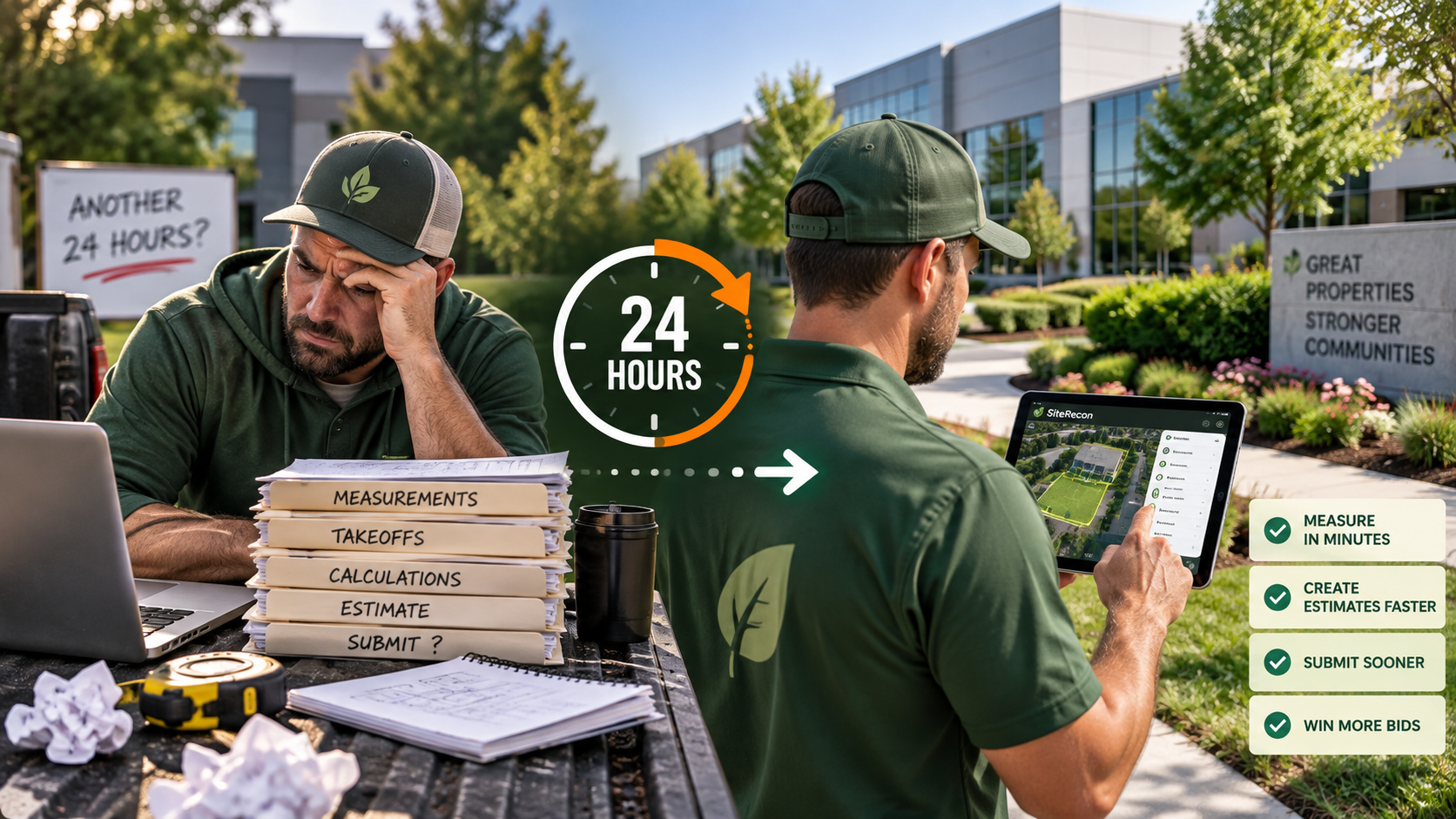
Here's a question most outdoor services operators have never calculated: what does a 24-hour proposal delay actually cost you?
Not in a theoretical sense. In real dollars, per bid, per season.
The answer is uncomfortable — and it's the reason the contractors winning the most commercial and residential contracts right now are the ones who've figured out how to close that gap.
The Estimating Gap: Where Bids Go to Die
The standard outdoor services estimating workflow has a structural flaw built into it: the site visit and the measurement happen at different times, in different places.
You drive to the property. You assess. You take notes or photos. Then you drive back to the office, pull up a satellite image, manually trace the property, run your calculations, and build the estimate. If you're efficient, this takes a few hours. If you're busy, it takes until tomorrow.
During that window, three things can happen — and none of them help you win:
● Your prospect gets a proposal from a competitor who moves faster
● The prospect's urgency cools and they decide to wait on the project
● Your own team's attention moves to the next problem, and the proposal gets pushed further
The proposal that goes out first wins disproportionately — especially on commercial accounts where decision-makers are comparing multiple bids simultaneously.

What a 24-Hour Delay Actually Costs
Let's put numbers to it. If your company submits 20 bids per week at an average contract value of $8,000, and your current win rate is 25%, you're closing 5 contracts per week for $40,000 in revenue.
Now assume a 27% improvement in win rate — which is what SiteRecon data shows for contractors using Scout AI. That's 6.35 contracts per week instead of 5. At $8,000 average contract value, that's an additional $10,800 per week. Over a 20-week active season, that's $216,000 in additional revenue — from moving faster, not working harder.
Win rate improvements come from multiple factors, but speed is consistently the most controllable variable — and the one most directly affected by measurement workflow.
Research from the Snow & Ice Management Association (SIMA) consistently shows that commercial snow removal contracts are awarded to contractors who respond fastest with accurate proposals during the pre-season bid window — often within days of a property manager's outreach.
How Mobile AI Measurements Fix the Gap
The fix isn't hiring a faster estimator or buying better software for the office. The fix is eliminating the return trip.
Scout AI measurements in the SiteRecon Plato app mean the measurement happens at the property — not back at the desk. Here's what the new workflow looks like:
● Arrive at property → open Plato on your phone
● Run Scout AI measurement → 95–98% accuracy in under 60 seconds
● Export to estimate template → proposal populated before you leave
● Send proposal from the parking lot
From site visit to sent proposal in the same morning. No office required.
The Compounding Benefit: More Bids, Same Effort
When measurements no longer require a return trip, your estimating team's capacity changes. An estimator who previously handled 4–5 site visits per day (with office time for takeoffs) can now handle more — because the takeoff happens at the site, not after it.
More proposals submitted per week. More opportunities in play. Higher revenue without adding headcount. That's the compounding math of faster estimating.
Start With 2 Free Measurements
Scout AI in Plato includes 2 free measurements per month, up to 10 acres each — available to any Plato user at no cost. Use them on your next two site visits and track how much time you save before the proposal goes out.
FAQs
In most cases, it's not the price — it's the proposal timing. Prospects often accept the first credible proposal they receive, especially for commercial accounts. Contractors who submit within hours of a site visit win disproportionately over those who submit the next day.
SiteRecon Scout AI measurements take under 60 seconds per property. Traditional manual takeoffs (satellite trace + area calculation) typically take 20–45 minutes per property. Scout AI is roughly 75% faster, with higher accuracy.
For most standard residential and commercial properties under 50 acres, mobile AI measurements match or exceed the accuracy of desktop takeoff tools. For highly complex properties requiring custom zone breakdowns, desktop access may still supplement mobile measurements.
SiteRecon customers using Scout AI in Plato consistently report same-day proposal turnaround on properties measured on-site — compared to the industry standard of 24–72 hours for desktop-based estimating workflows.
Take your business to the next level
Find out how SiteRecon's AI remote takeoff and land measurement tools can speed up pipeline, improve bid accuracy and increase sales
.png)

.avif)