
Your Free Production Rate Guide for Commercial Landscape Maintenance
The numbers your estimators need — for mowing, edging, pruning, mulching, and 12 other services — so every bid starts from a real baseline, not a gut feeling. Get the free guide.
Most Landscaping Companies Are Still Pricing From Memory
Every time a new bid goes out, someone on your team is making a judgment call. How fast can we mow this property? How long will the bed detail take? Is this shrub work easy or is it going to run over?
Those aren't estimating decisions — they're guesses. And when 10 estimates a week are built on guesses, the margin errors compound quietly until the P&L shows it.
Here's what high-performing commercial landscaping companies do differently: they start from verified production rates, not experience-based assumptions. That single shift — from gut-feel to documented baseline — is what makes estimating consistent, trainable, and scalable.
This free guide gives you the baseline production rates across every core maintenance service, structured by difficulty level, equipment size, and condition — so your team isn't reinventing the wheel on every bid.
Inside the Guide: Production Rates Across Every Core Maintenance Service
Industry-standard baselines — sourced from NALP — covering every service your crews deliver, broken out by difficulty and equipment type.
Turf Mowing Rates by Equipment Size
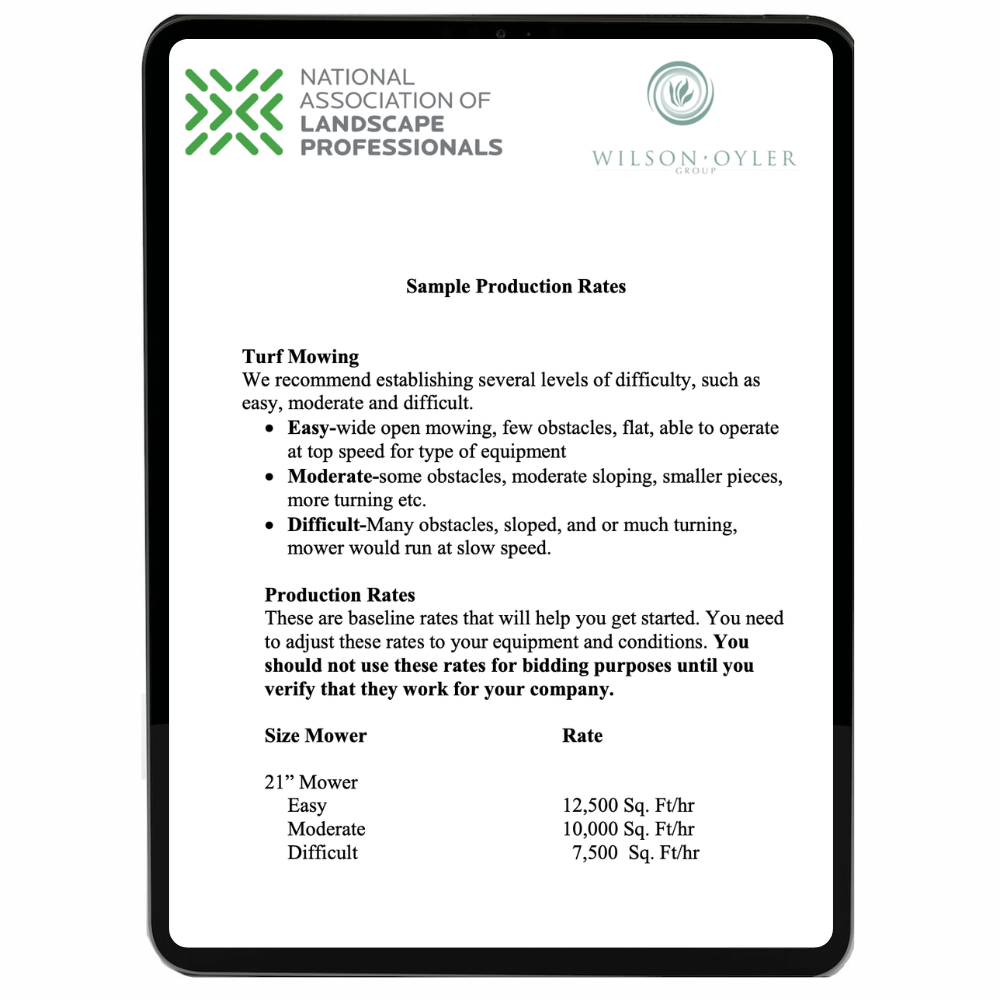
From 21" push mowers to 72" riders, this section breaks down sq. ft./hr across easy, moderate, and difficult conditions — so your estimate reflects the actual property, not the average one.
Edging, Trimming & Blower Cleanup
Hard edges, soft edges, string trimmer work, obstacle trimming, and blower cleanup — all with linear ft. and sq. ft. benchmarks that bring structure to the services most teams estimate loosely.
Bed & Color Work
Ground cover beds, shrub beds, slope work, color bed grooming, and dead-heading — with sq. ft./hr rates that account for regularity of maintenance and difficulty conditions.
Pruning — Shrubs, Hedges & Trees
Natural pruning, power shear hedging, ladder-required cuts, and small tree shaping — broken out individually so you're not applying one rate to wildly different scopes.
Specialty Services: Irrigation, Fertilizing, Spot Spray & Mulch
Valve-check rates, granular fertilizer coverage, backpack sprayer output, and mulch spread rates — the services that often get estimated as afterthoughts, with real numbers attached.
Two Estimators. Same Portfolio. Very Different Margins.
Is This Guide Right for You?
Built for $1M–$5M commercial landscaping contractors who are growing their bid volume and need their estimating process to keep up — without depending on a single person who "just knows."
Download this guide if you:

What's Inside: The Complete Production Rate Reference for Landscape Maintenance
Everything your estimating team needs to move from memory-based pricing to a structured, repeatable baseline — across every core service your crews deliver.
Turf Mowing — Full Rate Matrix
Six equipment sizes, three difficulty levels, 18 data points. Rates run from 12,500 sq. ft./hr for a 21" push mower on easy terrain up to 90,000 sq. ft./hr for a 72" rider — giving you a framework that fits any commercial portfolio, not just the easy ones.
Edging and Trimming — The Detail Work That Derails Budgets
Hard and soft edge rates, string trimmer benchmarks for obstacles, and blower cleanup coverage — the granular services most teams bundle loosely into a single line item that quietly eats hours.
Bed and Color Work — Regularity and Slope Matter
Ground cover beds vs. slope beds, regular maintenance vs. heavy weeding scenarios, and color bed grooming rates — structured so your estimate reflects what the crew will actually encounter.
Pruning — By Type, Not By Eyeball
Shrub pruning by individual plant size (small, medium, large), hedge pruning by surface area with and without ladder, and small tree shaping rates — because "pruning" on the estimate shouldn't mean a single number applied to 20 different situations.
Specialty Services With Real Numbers
Irrigation system check rates, granular fertilizer coverage with a push spreader, backpack spot spray output, and mulch spreading by cubic yard — the services that often get guessed at, with production data that makes them estimable.
How to Use These Rates (And When Not To)
The guide is explicit: these are starting baselines, not final bid rates. It walks you through how to calibrate them to your equipment, your crews, and your conditions — so the numbers you deploy are yours, not just industry averages.
The Estimators Who Price From Baselines Will Always Outcompete the Ones Who Don't
Every bid your team sends without a verified rate behind it is a bet. Sometimes it pays off. Sometimes it doesn't. And at scale — across a $3M or $5M maintenance portfolio — the cumulative cost of underpricing even one service category by 10% is real money left behind.
The companies building estimating infrastructure now — documented rates, difficulty tiers, service-by-service baselines — are the ones who can onboard faster, price cleaner, and protect margin without depending on institutional memory that walks out the door when someone quits.
FAQs
They're designed as starting baselines, not final bid rates. The guide is explicit: you need to verify these numbers against your own equipment, crew size, and site conditions before using them for pricing. Think of them as a calibration benchmark — the floor you measure from, not the number you submit.
The same mower covers 90,000 sq. ft./hr on a flat, open property — and only 70,000 on a sloped, obstacle-heavy one. That's a 22% swing, and it compounds across every service on the job. Ignoring difficulty tiers is one of the most common sources of margin erosion on maintenance contracts.
Because undocumented rates don't transfer. When your senior estimator prices from experience, that knowledge doesn't live anywhere that a new hire, a second branch, or a future buyer can access. Baseline documentation is how you convert expertise into infrastructure.
Turf mowing (6 equipment sizes), hard and soft edging, string trimmer work, blower cleanup, bed detail, color beds, shrub pruning, hedge pruning, tree pruning, irrigation check, spot spray, granular fertilizing, and mulch spreading — the full scope of a commercial maintenance operation.