
Your Free Guide to Building Commercial Landscape Maintenance Proposals That Actually Win
Property managers don't just buy a service — they buy confidence that you understand their property. This free e-guide shows commercial landscaping companies how to build proposals that address real client concerns, present solutions visually, and close contracts before a competitor gets the chance. Get the free guide.
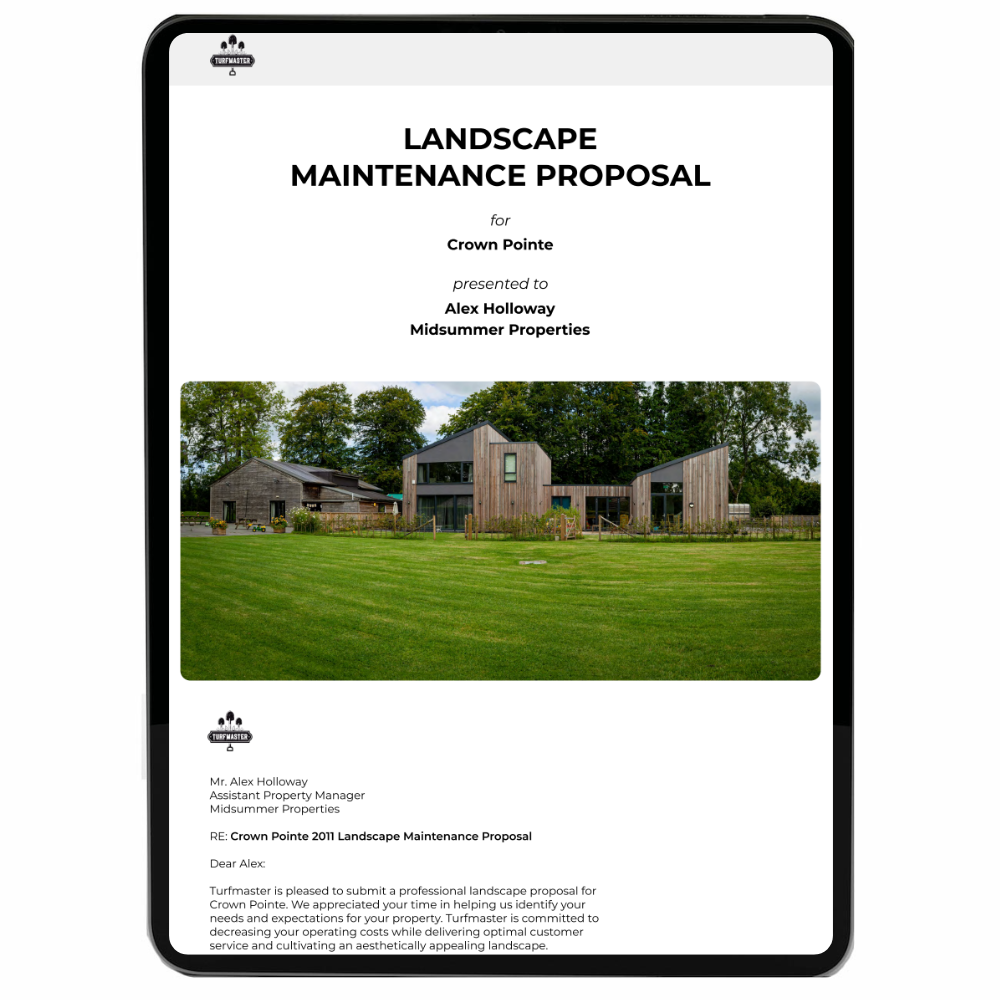
Your Competitors Are Sending the Same Proposal You Are
A line-item price sheet. A scope of services. Maybe a cover letter. And then you wait.
The property manager has three proposals in front of them. Yours is priced competitively. But it looks exactly like the other two — and it doesn't answer the one question they're actually asking: Do these people understand my property?
The landscaping companies winning the most commercial contracts aren't necessarily the cheapest. They're the ones whose proposals make the client feel understood before the first crew ever shows up. They've walked the property, documented the problems the client raised, named their account manager, and shown — visually — what the first 30 days will look like.
This free guide shows you exactly how to build that kind of proposal — from the cover letter to the site map to the pricing page — so every submission you make positions you as the obvious choice, not just another bidder.
Inside the Guide: A Proposal Structure That Wins Commercial Landscape Contracts
A section-by-section breakdown of what a high-converting commercial landscape maintenance proposal contains — and why each element builds the client's confidence in your team.
The Cover Letter That Sets the Tone
Most cover letters are generic. This section shows how to open with the client's specific concerns — the ones they shared during the proposal walkthrough — so the very first paragraph signals that you were listening.
Results in the First 30 Days
Clients want to know what changes immediately. This section covers how to present a property-specific 30-day action plan across turf, trees, shrubs, signage, and communication — before the contract is even signed.
The Visual Proposal: Site Maps and Digital Imaging
A proposal with a site map and before/after digital imaging communicates more than paragraphs ever could. This section shows how to use visual tools to present enhancement ideas and design proposals in a way that clients can actually respond to.
Your Team — Named and Accountable
Clients don't hire companies. They hire people. This section covers how to introduce your account manager, irrigation specialist, arborist, color designer, and enhancement team by name and role — turning an abstract service offering into a specific team accountable to this property.
Competitive Pricing That Fits Their Budget
Base management, optional value-adds, and enhancement services — structured and presented so the client understands exactly what they're buying, with no guesswork about what's included and what costs extra.
Two Proposals. Same Property. One Wins.
Is This Guide Right for You?
Built for commercial landscaping companies bidding on property management contracts — HOAs, office parks, retail centers, multi-property portfolios — where the decision-maker needs more than a price to say yes.
Download this guide if you:
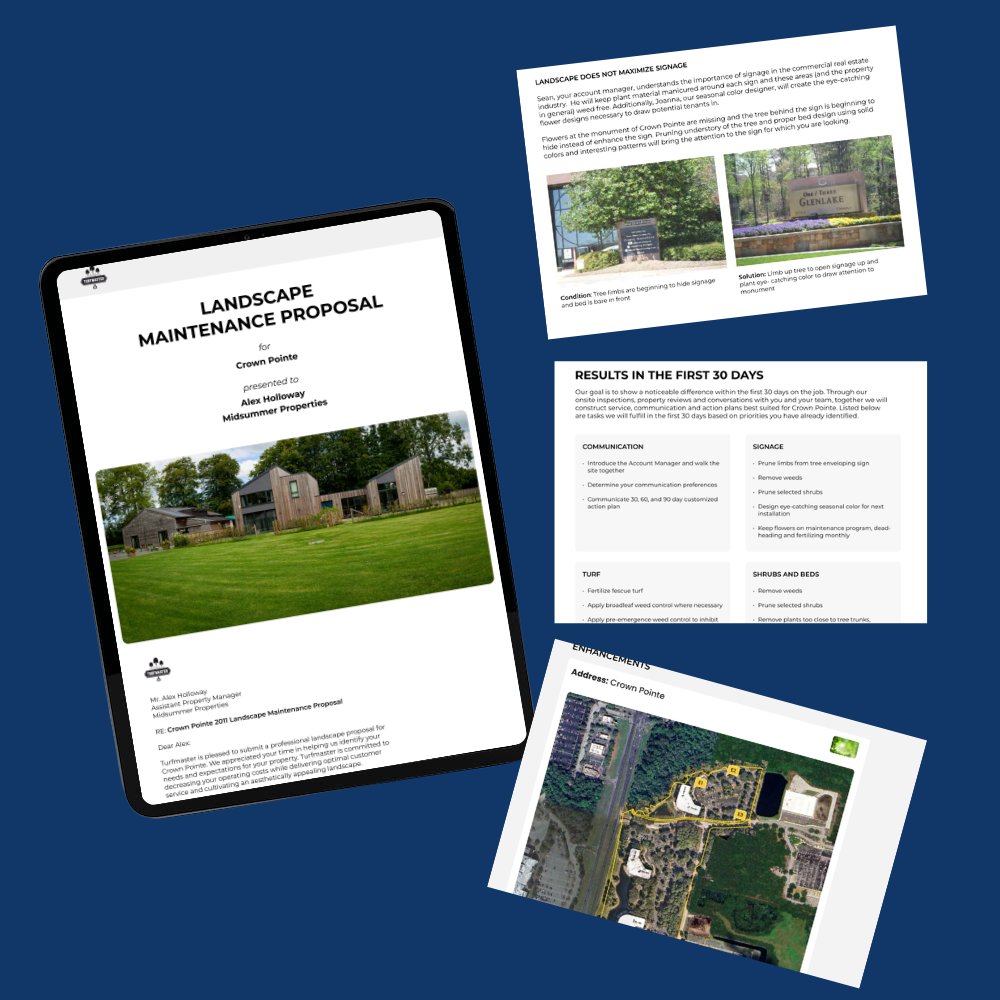
What's Inside: The Complete Commercial Landscape Maintenance Proposal Guide
Every element of a winning commercial proposal — from the first sentence of the cover letter to the optional services pricing page — explained and illustrated with a real proposal example.
The Cover Letter — Specific, Not Generic
Opens with the client's stated concerns, names the account manager assigned to the property, and commits to measurable outcomes. The example in the guide addresses three client priorities directly — signage presentation, cost reduction through perennial conversion, and proactive detail management — making it clear the proposal was written for this property, not copied from a template.
30-Day Results by Service Category
Communication, turf, trees, shrubs, signage, and enhancement ideas — each with specific first-30-day actions that show the client exactly what momentum looks like. Not "we will maintain your property." But: prune limbs from the tree hiding your sign, apply pre-emergence weed control, introduce the account manager, and establish your communication preference.
Site Map and Irrigation Location Mapping
Property-specific visual documentation that demonstrates you've done the work before the contract is signed. The guide shows how to use site maps to anchor the proposal and create a reference point for every service decision.
Digital Imaging for Enhancement Proposals
Before-and-after visuals that let clients see the difference between what exists today and what a well-executed enhancement plan delivers. The guide shows how digital imaging converts a vague enhancement conversation into a budgetable, visualized proposal the client can approve — and how it positions annual-to-perennial conversion as a cost-saving initiative, not just an aesthetic upgrade.
Team Introduction Page
Six named specialists — account manager, irrigation, pest control, seasonal color, enhancements, and arborist — each with defined responsibilities. The guide explains why naming your team builds the kind of accountability that generic proposals can't compete with.
Pricing Structure — Base, Optional, and Enhancement
Base management pricing, optional value-add services, and annual enhancement line items — presented in a format that separates what's included from what's available, giving the client budget clarity without burying them in a spreadsheet.
The Proposal That Understands the Property Wins the Contract
Property managers review multiple bids. They're not just evaluating price — they're evaluating confidence. Confidence that your team knows what the problems are. Confidence that there's a plan for the first 30 days. Confidence that there's a named person accountable for their satisfaction.
The proposal format in this guide builds all of that — before the contract is signed, before the first visit, and before your competitor has a chance to make the same case.
FAQs
Templates give you structure. This guide gives you the logic behind each section — why the cover letter should open with the client's specific concerns, why naming your team members matters, why digital imaging closes enhancement conversations faster than verbal descriptions. The format is only useful if you understand what each element is doing for the client's confidence.
No — the guide works without it, but the visual elements are where proposals most often separate themselves. Even basic before/after photography with annotated enhancement ideas communicates more than a written description. The guide shows you how to use whatever visual tools you have to make your proposal feel property-specific.
Before you write a single line. The entire proposal structure in this guide is built on information gathered during the client walkthrough — their stated priorities, the specific problems they've identified, the budget sensitivities they've expressed. Without the walkthrough, you're writing a generic proposal. With it, you're writing their proposal.
Yes — and it's especially effective there. Property managers overseeing multiple sites are evaluating whether your team can be trusted across a portfolio, not just a single location. A named team, a site-specific action plan, and a visual proposal signal the kind of operational maturity that earns portfolio-level relationships.